


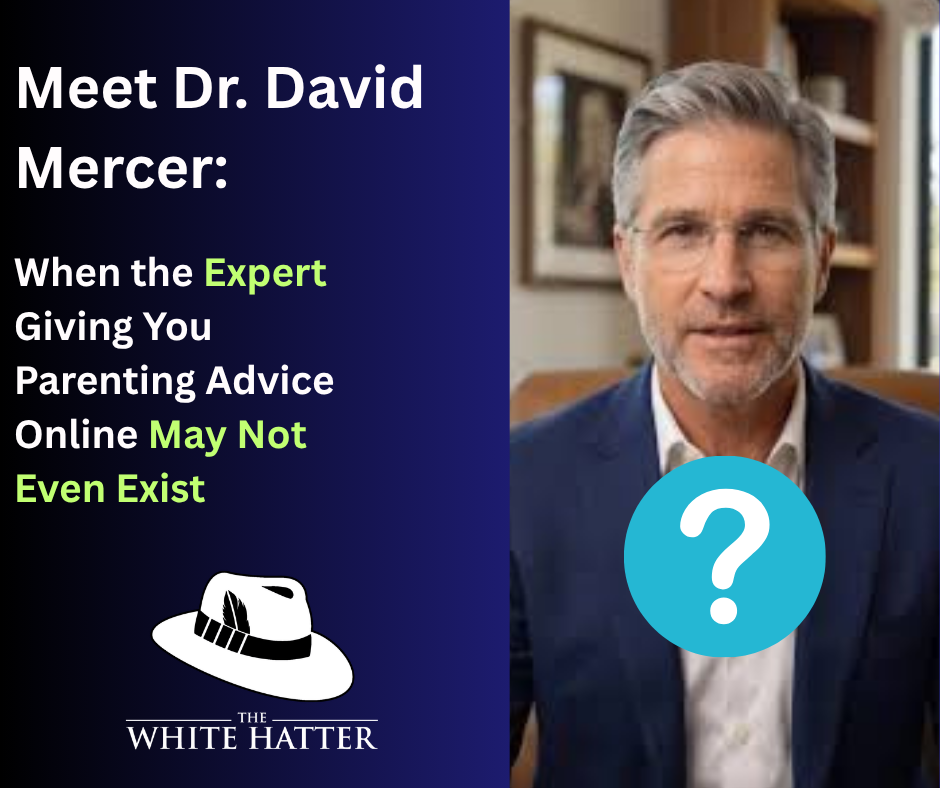
Meet “Dr. David Mercer”: When the Expert Giving You Parenting Advice Online May Not Even Exist

Caveat - This article was written as a case study to demonstrate why critical thinking, media literacy, and fact checking are becoming increasingly important in today’s onlife world, particularly as artificial intelligence plays a growing role in shaping the information we see, hear, trust, and share. As AI generated content becomes more realistic, persuasive, and difficult to distinguish from authentic human created material, the ability to pause, question, verify, and investigate before accepting something as fact is quickly becoming an essential onlife literacy skill.
There is a video presently appearing across several social media platforms where the person is promoting himself as “Dr. David Mercer”(1). His professionally produced videos discuss children, parenting, social media, technology, and child development, often delivering strong warnings about technology and recommendations about how parents and caregivers should manage it within their families. At first glance, there is nothing particularly unusual about this. Social media is filled with reputable doctors, psychologists, researchers, educators, therapists, and other professionals who use these platforms to share their knowledge and experience. Many legitimate professionals are doing excellent work translating complicated research into information that parents, caregivers, and educators can understand and use. However, something about this particular account caught our attention, and once we started looking more closely, what we found raised some important questions that extend far beyond one person, one account, or one social media platform.
The videos themselves are polished and professionally presented. The person speaking appears confident, articulate, knowledgeable, and authoritative. The scripts sound professional, the visuals reinforce the message being delivered, and the overall production creates the impression that the viewer is listening to someone with significant expertise in child development and parenting. Perhaps most importantly, the name attached to the account is preceded by one extremely powerful two letter credential - “Dr.”
For many people, that title immediately creates a level of credibility and authority. We have been culturally conditioned, for understandable reasons, to give greater weight to information coming from doctors and other highly credentialed professionals. However, when we attempted to independently verify the professional identity and qualifications associated with the “Dr. David Mercer” being presented through these social media accounts, we ran into a significant problem, we could not independently establish that the person being presented is actually a doctor or a qualified child development expert the account appears to represent.
When Something Sounds Familiar
What initially caused us to investigate the account wasn’t necessarily the appearance of the person in the videos. Rather, it was something he was saying. One particular video contained messaging, scripting, and visual examples that were remarkably similar to disinformation material we had previously researched for an earlier article involving young adults who were using artificial intelligence to create social media content as a money making side hustle (2). The similarities were significant enough that they caused us to stop watching the video as passive consumers and start examining the source behind the message. This is an important point because sometimes misinformation, synthetic media, or questionable online content is not identified because of an obvious visual mistake. Sometimes it is a small inconsistency, a familiar script, an unusual phrase, a recycled example, or something else that simply causes us to ask, “Who exactly is this person, and why should we trust what they are saying?”
The social media profile we saw presents “Dr. David Mercer” as someone with expertise in child development and primary education and claims more than 20 years of experience. The account also promotes more than “150+ printable tools parents actually use,” further reinforcing the impression that this is an established professional with a substantial body of work behind them. However, when we attempted to independently verify the credentials being presented, we could not locate the type of professional information we would normally expect to find when someone publicly positions themselves as a doctor and established child development specialist. We could not establish from the account what doctorate the individual supposedly holds, where that doctorate was earned, what institution granted it, what professional organization or regulatory body they may belong to, where they have practised or worked professionally, what educational institution they have been affiliated with, or what research, professional publications, conference presentations, or other independently verifiable professional work can be attributed to the individual portrayed in these videos.
When we looked beyond the social media profile and examined the website connected to the “Dr. David Mercer” persona, things became even more interesting. GrowingKids.shop publicly describes Dr. Mercer as its founder, yet its own Privacy Policy directs privacy inquiries to an email address “support@growingkids.com which comes back as an invalid email address that does not exist, and lists a London address as the contact location for the site’s data controller. That exact address is also the registered office of Vexora Group Ltd, a UK company incorporated in March 2026 whose sole director appears to be the same person and the director of Growingkids.shop, according to official Companies House records. We have found no public information explaining the relationship between Vexora Group Ltd, GrowingKids, and the “Dr. David Mercer” persona. None of this proves that Dr Mercer isn’t a real Doctor, but it demonstrates exactly why we should look beyond a polished video, professional title, and social-media biography when establishing someone’s identity and credentials
It is important for us to be equally careful about what this does and does not prove. The absence of an easily discoverable professional footprint does not automatically prove that someone is fake, and it does not mean the title “Dr.” necessarily mean that someone is claiming to be a medical doctor. A person may legitimately use the title after earning a PhD, EdD, PsyD, or another recognized doctoral degree, and not every legitimate professional maintains an extensive online presence. However, when someone is deliberately using professional authority to influence potentially thousands or even millions of parents, caregivers, and educators, we believe it is entirely reasonable to expect that the authority being presented should be independently verifiable. The issue isn’t simply whether someone is allowed to call themselves “Dr.” The more important question is whether the qualifications being implied by the presentation can actually be connected to the person delivering the advice.
Finding the Same Name Is Not the Same as Verifying the Person
Our investigation also demonstrated another emerging challenge associated with verifying identities online. There are, in fact, real doctors named David Mercer. We located a psychologist, a physician and a surgeon, by that name whose medical background can be independently verified. However, we could find no connection between those real doctors and the child development and parenting persona appearing in the social media videos we were examining. This distinction is extremely important because simply finding a legitimate professional who happens to have the same name as someone appearing online does not verify the identity of the person appearing in a particular social media account.
This creates an interesting vulnerability when it comes to synthetic or fabricated identities. A fake persona doesn’t necessarily need an unusual or completely invented name. In fact, using a believable name shared by real professionals can potentially make verification more difficult rather than easier. Imagine a parent watching a video from “Dr. David Mercer,” becoming curious about whether the person is legitimate, and conducting a quick Google search. Search results show that there really is a Dr. David Mercer working in medicine, so the parent or caregiver concludes that the person has been verified and returns to the video. However, all that search has actually established is that someone with that name exists. It has not established that the person in the video is that doctor, that the social media account belongs to that doctor, or that the professional qualifications being implied by the account belong to the individual speaking. Identity verification requires connecting the specific person, account, qualifications, and professional history together rather than simply finding a matching name somewhere on the internet.
Is “Dr. David Mercer” AI-Generated?
Based upon what we observed, we believe there are legitimate reasons to question whether the persona being presented in these videos may be AI generated or otherwise synthetically produced. However, without access to original media files, account ownership information, production records, metadata, or other forensic evidence, we cannot responsibly state as an absolute fact that the person appearing in every video was created using artificial intelligence. We think this distinction is particularly important because good digital literacy requires us to apply the same evidentiary standards to ourselves that we expect others to follow. It would be contradictory for us to write an article encouraging people to verify information while simultaneously presenting something we strongly suspect as something we have conclusively proven.
What we can say is that we were unable to independently verify the professional identity and qualifications represented by the account, and characteristics of the content raised sufficient questions for us to investigate further. In fact, we posted on his social media platform the following question, “Can you provide information specific to your "Dr." designation such as, is it an MD or PhD? What university you earned your Doctorate at, and can you also point me in the direction to any peer reviewed research papers you have written and published, and where do you practice or where office may be located?” As of the publication of this article, 3 days later, we have yet to receive a response. Interestingly, the account has continued to respond to other users who have asked for information about how to purchase products it is promoting.
From a digital literacy perspective, that fact alone should matter. The larger lesson isn’t ultimately dependent upon proving whether one particular face was created using one AI program, whether a real person was used to portray a fictional expert, whether the voice was synthesized, or whether some combination of traditional and AI production techniques was involved. The much more important issue is that we have entered an era where creating a convincing digital expert has become remarkably inexpensive and accessible. Generative artificial intelligence can now assist with creating realistic faces, synthetic voices, scripts, graphics, captions, supporting imagery, translations, virtual backgrounds, and entire videos. What once required a production team, actors, writers, editors, and significant financial resources can increasingly be accomplished by an individual using consumer level AI tools.
The New Authority Problem
This technological change creates what we believe is an emerging authority problem online. For years, digital literacy education has encouraged people to evaluate the information they encounter by asking questions such as, “Who published this information? What evidence supports the claim? Are other credible sources reporting the same thing?”, “Is the information current?”, “Is someone trying to sell something?”, and “Does the headline accurately reflect the underlying research?” These remain extremely important questions, but artificial intelligence is adding another question that increasingly needs to come before all of them, “Is the person speaking to me actually who they claim to be?”
This becomes particularly significant when a synthetic, fabricated, or unverifiable persona is presented as a doctor, psychologist, therapist, scientist, professor, teacher, police officer, lawyer, financial expert, or another individual whose perceived professional status naturally carries authority. Human beings use mental shortcuts when deciding whom to trust, and professional titles are one of those shortcuts. When we see “M.D.,” “Ph.D.,” “Dr.,” or “Professor” attached to someone’s name, most of us understandably assign additional credibility to what that person says. Add a professional looking office, bookshelf, microphone, medical graphics, calm delivery, expensive looking production, and confident language, and the perception of expertise becomes even stronger. The problem is that artificial intelligence can now manufacture virtually all of those signals of authority. A professional looking environment is not a credential, a confident voice is not expertise, and a title displayed beneath someone’s name is not proof that they earned it.
Professional Looking No Longer Means Professionally Qualified
This is something we believe parents, caregivers, and educators need to begin explicitly teaching youth and teens. Production quality is no longer a reliable indicator of credibility. There was once a time when producing a professional looking educational video generally required cameras, lighting, microphones, editors, graphic designers, studios, actors, and significant financial resources. Those barriers didn’t guarantee that the information being produced was accurate, but they did create friction that made the mass production of highly convincing false content more difficult and expensive. Generative AI is rapidly removing much of that friction.
Someone sitting at home can now potentially create a person who doesn’t exist, assign that person a professional title they never earned, place them inside a convincing virtual office or clinical environment, have them deliver an AI generated script, add professional graphics and citations, and distribute the resulting video globally. If the algorithm rewards the content, that synthetic expert can potentially reach hundreds of thousands or millions of people without ever having attended medical school, completed a doctorate, conducted research, worked with children, or held the professional qualifications being implied. This fundamentally changes how we need to evaluate authority online because the traditional visual signals that once helped us determine whether something looked professional are becoming increasingly easy to manufacture.
Thousands of Likes Are Not Peer Review
One of the things that concerned us when examining this content was the apparent engagement surrounding it. Videos had accumulated significant numbers of likes and shares, and based upon the comments we reviewed, many of the people interacting with the content appeared to be parents and caregivers who accepted the information and professional authority being presented. This is not a criticism of those parents and caregivers. The content is specifically designed and presented in a way that encourages trust. When someone appears professional, speaks confidently, uses the title “Dr.,” discusses child development, and delivers information that sounds plausible, most people are not going to immediately conduct a professional credential investigation before clicking “like” or “share.”
However, this is precisely why we need to remind ourselves and our children that popularity is not evidence. A video receiving a thousand likes does not make its claims scientifically accurate. Tens of thousands of shares do not establish someone’s professional qualifications. A million views do not transform an opinion into research, and a large follower count does not constitute peer review. Social media algorithms generally do not rank information according to academic quality, professional credentials, scientific accuracy, or the strength of the evidence supporting a claim. They prioritize content that captures attention and generates engagement, fear generates engagement, anger generates engagement, controversy generates engagement, and simple answers to complicated parenting problems generate engagement. A convincing “doctor” confidently telling parents that technology is harming their children’s development can therefore become enormously successful online regardless of whether the person delivering that message has the qualifications being implied.
When AI Slop Doesn’t Look Like Slop
The term “AI slop” is increasingly being used to describe the enormous amount of low quality, repetitive, derivative, misleading, or mass produced content being generated with artificial intelligence. However, we believe the word “slop” itself may unintentionally cause people to underestimate the problem. When many people hear “AI slop,” they imagine obviously artificial photographs with six fingers, distorted faces, nonsensical text, bizarre animals, strange voices, or videos that can be identified as fake within seconds. Those examples certainly exist, but the technology is improving extraordinarily quickly, which means the next generation of AI generated misinformation may not look like “slop” at all.
The faces are becoming more convincing, voices more natural, lip synchronization more accurate, scripts more sophisticated, and video production increasingly difficult for the average person to distinguish from traditionally produced content. More importantly, AI generated content can be made to look educational, thoughtful, evidence based, and authoritative. It can reference research, display graphs, quote statistics, create realistic medical environments, and present an apparently knowledgeable professional who calmly explains why parents should believe something. The future challenge isn’t simply going to be spotting obviously fake content. The far greater challenge will be recognizing potentially false or misleading content that looks completely legitimate. AI slop may increasingly arrive wearing a lab coat, standing in front of a bookshelf, speaking confidently, displaying a professional credential, and telling us exactly what we already believe.
Confirmation Bias Makes Synthetic Expertise More Powerful
That last point is especially important because misinformation is often most persuasive when it confirms something we already believe, fear, or hope to be true. If a parent or caregiver already believes that social media is destroying childhood, a professionally produced video from someone presented as a child development doctor making exactly that argument may immediately feel credible. If someone already believes smartphones are responsible for a particular psychological or developmental problem, they may be less likely to investigate the credentials of an apparent expert who confirms that belief. The content doesn’t have to persuade them to adopt a completely new worldview. It simply needs to reinforce the worldview they already have.
This is known as confirmation bias, and none of us are immune to it. In fact, we would argue that sometimes the information we agree with the most deserves the greatest scrutiny, because agreement can lower our natural skepticism. It is relatively easy to fact check someone who is saying something we strongly disagree with because we are already motivated to find weaknesses in their argument. The greater test of digital literacy is whether we are willing to apply that same scrutiny to people who are saying exactly what we want to hear. Digital literacy isn’t simply about fact checking information that challenges our beliefs, it also requires us to fact check information that validates them.
Teach Lateral Reading Rather Than Simply Watching
This is where examples such as this can become extremely valuable teaching opportunities for parents, caregivers, educators, youth, and teens. When someone online claims professional expertise, don’t remain inside their Instagram profile, TikTok account, YouTube channel, or website looking for evidence that they are legitimate. The information presented inside that environment is controlled by the person or organization whose credibility you are trying to establish. Instead, move laterally across the internet and independently investigate the person, their qualifications, and the claims being made. This process is commonly referred to as lateral reading, and it is becoming one of the most important skills we can teach in today’s information environment (3).
Search the person’s full name independently. Search their claimed professional designation. Look for the university where they supposedly trained and determine whether that institution recognizes them. Search the professional regulatory body that should oversee their profession. If they claim to be a researcher, look for academic publications. If they claim to be a physician, determine whether they appear in an appropriate medical registry. If they claim to be a professor, look for an institutional biography. If they claim decades of experience, look for professional footprints consistent with that history, such as conference presentations, research papers, organizational affiliations, interviews, publications, or previous employment. Most importantly, connect those findings back to the specific person appearing in the social media account. Finding someone with the same name isn’t enough.
Four Words We Need to Teach Our Kids and Ourselves: “How Do We Know?”
One of the most valuable questions we believe parents and educators can teach youth and teens in the age of generative artificial intelligence consists of just four words: “How do we know?” Someone says they are a doctor, how do we know? Someone claims that research proves a particular technology damages a child’s brain, how do we know? Someone presents a graph showing dramatic increases in mental health problems, where did the data come from? Someone quotes a scientific study, can we locate and read the actual study? Someone says they have 20 years of professional experience, can that experience be independently verified? Someone has a million followers and thousands of positive comments, what does that actually tell us about the accuracy of their information?
Teaching youth to ask these questions is far more sustainable than simply teaching them to look for visual glitches in AI generated faces, fingers, eyes, mouth movements, reflections, or voices. Those detection strategies may occasionally be useful today, but they have a very short shelf life because the technology producing synthetic media will continue improving (4)(5). Verification is much more durable. Rather than attempting to become human AI detectors, which will become increasingly difficult, youth need to become skilled information investigators who understand how to verify sources, identities, credentials, evidence, and claims.
This Is Bigger Than One Social Media Account
We aren’t writing this article simply to draw attention to one social media persona. In many ways, “Dr. David Mercer” is simply a useful case study for something much larger that parents, caregivers, educators, youth, and teens are going to encounter with increasing frequency. The internet has always contained misinformation, fake identities, fabricated credentials, impersonators, scammers, and people pretending to possess expertise they don’t actually have. Artificial intelligence did not invent deception. What AI has done is dramatically reduce the cost, time, technical skill, and resources required to make deception look professional, believable, and authoritative at scale.
That changes the digital literacy equation. For years, adults have told children, “Don’t believe everything you read online.” Later, as social media and online video became more prominent, that evolved into “Don’t believe everything you see online.” In the age of generative artificial intelligence, we now need to add another layer, “Don’t automatically believe everyone you see online is who they claim to be.” This doesn’t mean teaching children that everyone online is lying or that nothing can be trusted. That would simply replace gullibility with cynicism. Instead, we need to teach them that trust, particularly when someone is claiming professional expertise, should be supported by independently verifiable evidence.
From Fact-Checking to Identity and Credential Checking
For parents, caregivers, and educators, this means our approach to digital literacy needs to evolve beyond traditional fact checking. Fact checking remains essential, but we also need to normalize identity checking, credential checking, and source checking. When someone uses professional qualifications to strengthen their message, checking those qualifications should not be considered disrespectful or unnecessarily suspicious. It should increasingly be viewed as normal digital hygiene, particularly when the advice involves a child’s health, development, education, safety, or well-being.
Legitimate professional expertise generally leaves verifiable footprints. Physicians can often be found through licensing or professional registries. Psychologists and other regulated professionals may belong to provincial or state regulatory bodies. Professors generally have university affiliations. Researchers publish papers. Authors have publication histories. Professionals who have spent decades working within a field frequently leave traces through conferences, organizations, media appearances, institutional biographies, professional associations, research databases, or previous employment. There will always be exceptions, but when someone claims substantial expertise while simultaneously building a large social media following, selling products, promoting downloadable resources, or attempting to influence parenting decisions, asking for independent evidence of their qualifications is entirely reasonable.
Don’t Outsource Your Parenting Decisions to an Algorithm
There is another lesson here that we believe is particularly important for parents and caregivers. Social media has created an enormous parenting advice industry where parents are constantly being told what they should fear, what they should ban, what they should buy, how much screen time their child should have, when they should receive a phone, which apps they should avoid, what social media supposedly does to their child’s brain, and what will happen if they don’t follow a particular parenting philosophy. Some of this information comes from highly qualified experts doing excellent work. Some comes from thoughtful parents sharing legitimate lived experience. Some comes from influencers building audiences. Some comes from companies selling products and services. Some comes from people exaggerating or misrepresenting their qualifications. Increasingly, some of it may come from professionally presented people who may not exist in the way they are being represented at all.
Parents and caregivers deserve to know the difference, particularly because algorithms are exceptionally good at repeatedly feeding us information similar to content with which we have previously interacted. Watch several videos warning about smartphones, social media, gaming, or artificial intelligence, and the platform may increasingly surround you with more creators delivering similar messages. Eventually, repetition itself can create the perception of consensus. When five, ten, or twenty apparent “experts” begin saying similar things, it can feel as though the scientific community has reached an overwhelming conclusion, even when some of those experts may not have relevant qualifications or, increasingly, may potentially be synthetic personas created specifically to produce engagement.
The More Powerful AI Becomes, the More Important Human Judgment Becomes
There is an interesting irony in all of this. The more sophisticated artificial intelligence becomes, the more important very human skills such as curiosity, skepticism, reasoning, judgment, media literacy, and critical thinking become. Our children do not need to become frightened that everything they encounter online is fake, and parents do not need to conduct a forensic investigation every time they watch a TikTok or Instagram Reel, that would be neither realistic or healthy. What we need instead is a proportional approach where the importance of verification increases with the importance of the claim. A funny video about a dog doesn’t require the same level of scrutiny as someone claiming to be a doctor providing advice about your child’s development.
There is also an important difference between skepticism and cynicism that we believe needs to be emphasized. Cynicism says, “Nothing online can be trusted.” Digital literacy says, “Trust should be proportional to the evidence supporting it.” The first response leaves us suspicious of everything. The second gives us the skills necessary to determine what deserves our confidence. This distinction will become increasingly important as AI generated and AI assisted content becomes indistinguishable from traditionally produced media.
The Question Is No Longer Simply, “Is This True?”
The challenge of the AI era will not simply be identifying fake photographs, deepfake videos, synthetic voices, AI-generated influencers, or other forms of manipulated media. The much larger challenge will be determining who and what deserves our trust when artificial intelligence can manufacture the appearance of authority almost as easily as it can manufacture an image. The visual and social signals we once relied upon, professional production, confident delivery, impressive titles, large audiences, thousands of likes, supportive comments, and even a realistic human face, can no longer carry the evidentiary weight we may once have given them.
This is why examples such as the “Dr. David Mercer” account are so valuable from a digital literacy perspective. Whether this particular persona ultimately proves to be entirely AI generated, partially AI assisted, performed by a real person representing a constructed identity, or something else, the exercise of trying to independently verify the person and their qualifications demonstrates the larger lesson. We should not automatically accept authority simply because someone looks authoritative, sounds authoritative, or places professional credentials beside their name.
For parents, caregivers, educators, youth, and teens, the question is therefore no longer simply, “Is this information true?” Increasingly, we also need to ask, “Who is telling me this, what qualifies them to say it, what evidence supports what they are saying, and how can I independently verify that they are who they claim to be?”
In today’s onlife world, those questions are no longer just useful media literacy skills. They are becoming essential skills for navigating an information environment where seeing, hearing, and even interacting with someone online no longer guarantees that the person, expertise, or authority being presented is what it appears to be.
Digital Food for Thought
The White Hatter
Facts Not Fear, Facts Not Emotions, Enlighten Not Frighten, Know Tech Not No Tech
Reference


