


Where Does Your Child Charge Their Phone at Night? Why It Matters More Than You Think!

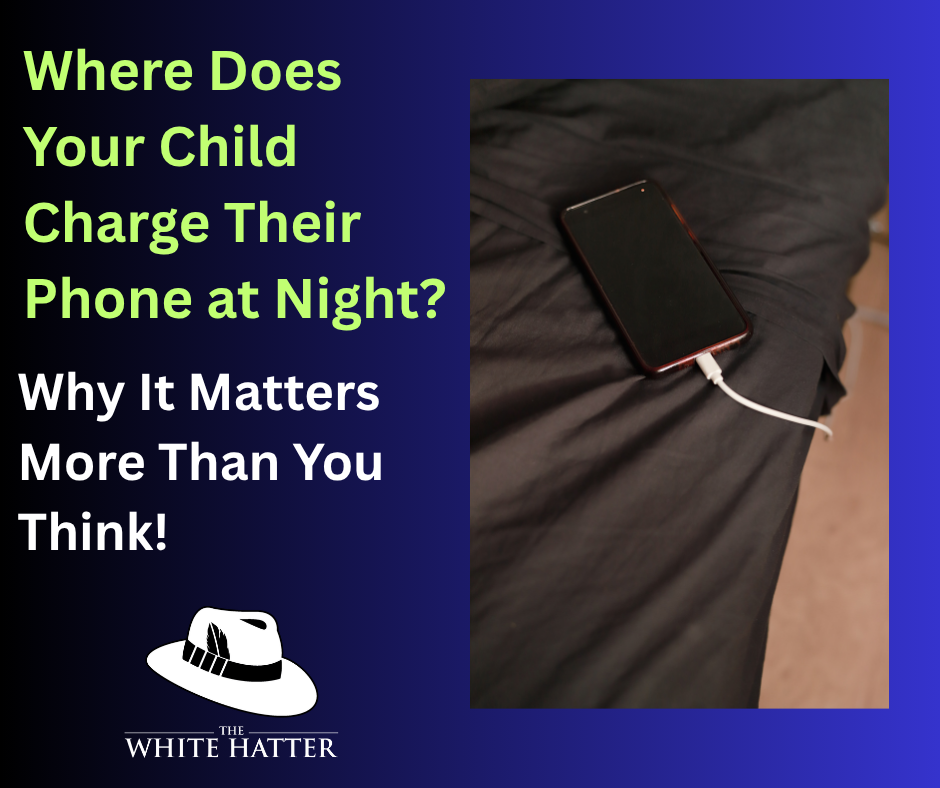
CAVEAT: We here at The White Hatter have long recommended a clear family rule that, except where there is a legitimate medical, accessibility, safety, or other necessary reason, youth and teens should not have their cellphones in their bedrooms overnight. Our primary reasons for this recommendation have traditionally focused on protecting healthy sleep and reducing the opportunity for late night scrolling, messaging, gaming, or other online activities that may be inappropriate or interfere with much needed rest.
However, there is another reason that parents and caregivers may not have considered, how and where that cellphone is being charged overnight. As you will read in this article, the lithium-ion battery inside your child’s phone introduces an additional safety consideration, particularly when a phone is being charged on a bed, underneath a pillow or blanket, surrounded by combustible materials, or in another location where heat may not be able to dissipate effectively.
Most parents and caregivers probably don’t give much thought to where their child plugs in their cellphone at night. The phone gets connected to a charger, placed beside the bed, and everyone goes to sleep. However, where and how a cellphone is charged deserves some attention, particularly because today’s smartphones are powered by lithium-ion batteries. These batteries are remarkably safe considering the billions of devices that use them every day, but like any energy storage technology, they are not completely without risk.
We want to begin with some important context. This is not an article suggesting that parents and caregivers should be frightened of cellphone batteries, and we are not suggesting that charging a phone normally is inherently dangerous. Millions of smartphones are charged every day without incident. However, lithium-ion batteries store a significant amount of energy in a very small space. If a battery is damaged, defective, improperly manufactured, exposed to excessive heat, or experiences an internal electrical failure, that stored energy can potentially be released very quickly through a process known as “thermal runaway.” In rare circumstances, the result can be smoke, extremely hot gases, fire, and even the ignition of nearby combustible materials. Health Canada specifically identifies overheating, damage, improper charging, and defects as circumstances that can contribute to lithium-ion battery failures and fires (1).
Charging Creates Heat, and That Heat Needs Somewhere to Go
A cellphone will normally become somewhat warm while charging and this does not mean something is wrong. Both the battery and the charging electronics can generate heat during normal operation, particularly during faster charging. Smartphones also contain battery management systems designed to monitor temperature, voltage, and charging conditions. The concern arises when normal heat cannot dissipate effectively or when something abnormal is happening inside the battery.
This is one reason why charging a phone underneath a pillow, buried under blankets, sitting between couch cushions, or placed on other soft insulating materials is not recommended. These environments can trap heat around the device. They also place combustible materials immediately beside the phone should a battery or charger fail.
Health Canada specifically advises Canadians to charge lithium-ion powered products away from soft surfaces and bedding to prevent overheating. Its safety guidance warns against charging products on couches or beds because soft surfaces can trap heat around a battery and potentially result in overheating or fire (2).
In March 2022, approximately 25 firefighters from the London Fire Brigade responded to a house fire in Harrow, England. According to the fire brigade’s investigation, the fire was believed to have been caused by the failure of a lithium-ion battery for a cellphone that was charging while sitting on bedding. Half of the ground floor of the home was damaged (3).
More recently, in February 2026, Hampshire and Isle of Wight Fire and Rescue Service responded to a house fire involving a cellphone that had been charging on a bed. Following the incident, the fire service specifically reminded the public not to cover lithium batteries while they are charging and to keep charging devices away from combustible materials (4).
There have also been warnings here in Canada. Canadian fire departments are increasingly drawing attention to fires involving lithium-ion batteries and the importance of charging these devices appropriately. Toronto Fire Services, for example, documented 29 lithium-ion battery fires in 2022, 55 in 2023, and 76 in 2024, representing a 38 per cent increase between 2023 and 2024 (5). These numbers include many different lithium-ion powered products and should not be interpreted as 76 cellphone fires. However, they demonstrate why Canadian fire services and public safety agencies are paying increasing attention to lithium-ion battery safety.
Here in British Columbia, the Mill Bay Fire Department has also specifically advised people to charge devices on hard surfaces rather than underneath pillows, on beds, or on couches, warning that doing otherwise could contribute to a fire (6).
Again, context matters. The overwhelming majority of cellphones will never catch fire. However, low probability does not mean zero probability, particularly when a few very simple behaviours can reduce the risk even further.
Ventilation Versus Heat Dissipation
Parents and caregivers will sometimes hear that lithium-ion batteries “need ventilation” while charging. We think there is a more accurate way of explaining this. A healthy cellphone battery does not normally release gases that have to be ventilated from a room while it charges. Under normal conditions, the battery is a sealed system. What the phone does need is an environment where the heat generated during charging can dissipate, think airflow and heat management rather than simply ventilation.
Placing a phone on a hard, open surface allows heat to dissipate much more readily than placing it beneath a pillow or wrapping it in bedding. This is consistent with Health Canada’s recommendation to keep charging lithium-ion devices away from soft surfaces that can trap heat (2). Similarly, enclosing a charging phone inside a container, pouch, drawer, backpack, locker, or other poorly ventilated space deserves additional consideration, particularly if several battery-powered devices are being charged together.
This does not automatically mean that every enclosure is unsafe. Purpose built charging cabinets and storage systems can be engineered with electrical protection, thermal management, appropriate materials, spacing, ventilation, and other safety features. However, simply placing multiple charging devices into an ordinary enclosed container is not necessarily equivalent to leaving those same devices exposed on an open countertop.
There is another consideration as well. If a lithium-ion battery enters thermal runaway, ventilation alone will not necessarily prevent a fire. A failing battery can produce extremely high temperatures and flammable gases. This is why battery safety involves more than simply drilling some holes into a container. Heat management, electrical design, fire-resistant construction, separation between batteries, charger quality, battery condition, and the ability to detect and respond to a failure can all matter.
Teach Kids the Warning Signs
Parents and caregivers should also teach children that a phone behaving unusually while charging shouldn’t simply be ignored. Stop charging or using a device if the battery is visibly swelling, the phone becomes unusually hot, the case begins separating, there is an unusual odour, the device begins hissing or popping, or smoke appears. Health Canada advises consumers not to use lithium-ion batteries showing signs of damage, including swelling or overheating, and recommends following appropriate procedures for their disposal (1).
A swollen lithium-ion battery should never be punctured, squeezed, bent, or deliberately opened. Parents or caregivers should contact the manufacturer, retailer, or an appropriate battery/electronics recycling facility for guidance about safe handling and disposal.
The charger matters as well. Extremely inexpensive, counterfeit, damaged, or uncertified charging equipment can introduce another potential point of failure. Health Canada recommends using the charger supplied with the product or another charger specifically designed and approved for use with that device (1)(2).
Our Family Charging Rules Suggestions
Here are some simple rules that we believe families can easily incorporate into their Family Technology Agreement:
Charge on a hard, open surface. A desk, countertop, shelf, or bedside table is preferable to bedding, couches, carpets, or upholstered furniture.
Never charge underneath a pillow or blanket. Phones need to be able to dissipate the heat generated while charging.
Keep charging devices away from easily combustible materials. Don’t surround a charging phone with clothing, paper, bedding, or other materials that can readily burn.
Don’t ignore excessive heat. Slight warmth can be normal. A device becoming unusually or painfully hot deserves attention.
Inspect damaged devices. A phone that has been crushed, badly dropped, bent, punctured, or has a swollen battery should not simply be plugged back in.
Use reputable charging equipment. Damaged cables, questionable adapters, counterfeit chargers, and incompatible charging equipment aren’t worth the risk.
Think carefully before charging devices inside enclosed spaces. Bags, drawers, lockers, pouches, cabinets, and containers can affect how effectively heat dissipates, particularly when multiple devices are charging together. This does not mean every enclosure is unsafe, but any system designed for charging multiple lithium-ion devices should account for heat management and battery failure rather than simply assuming that because the devices fit inside, they can safely be charged there.
Have working smoke alarms. Lithium-ion battery safety is another reason every home should have properly located and functioning smoke alarms.
Modern smartphones incorporate numerous battery and charging protections, and hundreds of millions of people safely charge their devices every night. The lesson isn’t to fear lithium-ion technology, the lesson is to understand it well enough to use it safely.
A phone shouldn’t be charging underneath a pillow, it shouldn’t be buried underneath blankets, a damaged or swollen battery shouldn’t be ignored, and a charging device shouldn’t be unnecessarily surrounded by combustible materials or placed somewhere that significantly restricts its ability to shed heat. These are small behavioural changes that cost families nothing and require very little effort.
We frequently tell parents and caregivers that good digital literacy isn’t only about understanding what happens on the screen. Increasingly, it also means understanding the technology sitting in our hands, pockets, bedrooms, backpacks, and homes. Knowing how to safely charge the lithium-ion battery powering your child’s phone is simply another part of raising digitally literate kids in today’s onlife world.
P.S. Although this article focuses on youth and teens, these recommendations apply equally to us adults. After all, plenty of us keep our phones beside the bed and charge them overnight too. Sometimes the digital safety advice we give our kids is advice we need to follow ourselves. Just saying!
Digital Food For Thought
The White Hatter
Facts Not Fear, Facts Not Emotions, Enlighten Not Frighten, Know Tech Not No Tech
References
1/ https://www.canada.ca/en/health-canada/services/household-products/battery-safety/lithium-ion.html


