


From Social Media, to Social AI, to Trusted Digital Communities: The Next Digital Migration Is Happening With Youth.


Caveat - Before we dive into where we are seeing youth and teens migrating online, it is important to acknowledge that none of us can accurately predict the future. Technology has a way of surprising even those who work in it every day. However, one of the advantages we have here at The White Hatter is that we spend every day speaking with thousands of students, hundreds of parents and educators, law enforcement professionals, researchers, and technology experts. When you combine those conversations with what we are seeing in emerging technology and the changing behaviours of young people, certain patterns begin to emerge. While we cannot say with certainty what social media will look like five years from now, we can identify trends that parents, caregivers, and educators would be wise to start paying attention to today.
We believe how youth and teens are using social media is undergoing a fundamental transformation. What was once built around friends, followers, and public sharing is increasingly being shaped by artificial intelligence, recommendation algorithms, and synthetic content. AI is no longer simply recommending what we see, it’s creating the content itself, generating images, videos, conversations, and even virtual personalities that can be difficult to distinguish from real people. As the line between authentic human interaction and AI generated participation continues to blur, the online environment is becoming more complex than ever before.
At the same time, we are observing another important shift through our work with youth and teens across Canada this past school year. Many young people are growing weary and tired of algorithm driven feeds and AI generated content, and are instead choosing to spend more of their time in smaller, trusted digital communities. Private group chats, invite only Discord servers, gaming communities, and encrypted messaging platforms are becoming the places where many of their most meaningful conversations now occur. As artificial intelligence reshapes the online experience, many young people appear to be placing less value on public popularity social media platforms, and more value on authentic relationship based alternatives built on trust and genuine human connection.
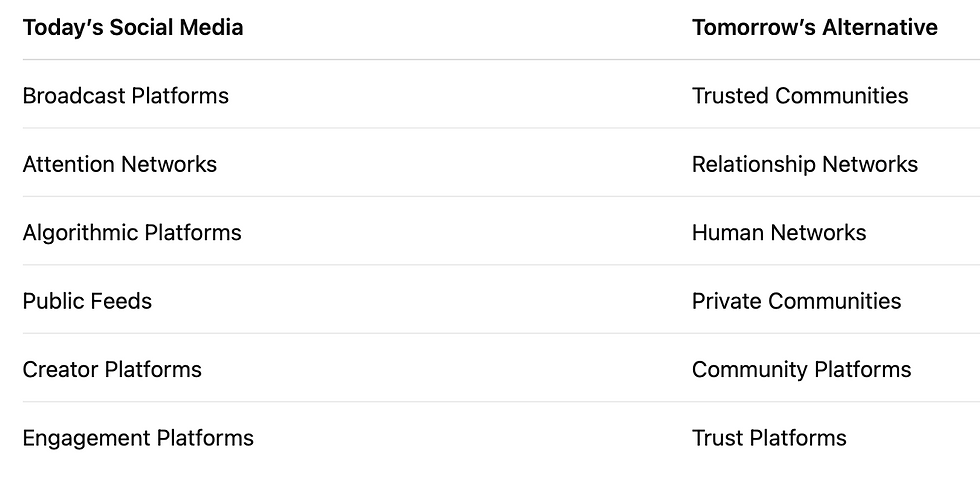
This migration carries important implications for parents, caregivers, educators, and policymakers. While these smaller communities can foster genuine relationships and positive collaboration, they are also less visible when problems such as cyberbullying, grooming, exploitation, or sextortion occur. It also raises questions about whether legislation focused primarily on restricting access to traditional social media platforms will remain effective as young people continue to adapt and migrate elsewhere. Rather than building policy around specific platforms, we believe the more enduring solution is to equip children with the judgment, critical thinking, digital literacy, AI literacy, and strong human values they will need to navigate whatever digital spaces emerge next.
Based on what we are seeing and hearing from thousands of students across Canada, we are witnessing a gradual shift in where young people choose to invest their most meaningful online interactions. While platforms like TikTok remain incredibly popular for entertainment, discovering new content, and following creators, they are becoming less central to where youth and teens build and maintain their closest relationships.
Instead, many of their most authentic conversations are taking place in smaller, more trusted digital spaces. Private group chats, Discord servers, Snapchat messaging, gaming communities, and encrypted messaging apps are increasingly becoming the places where friendships are strengthened, conversations are more personal, and connections feel more genuine. While public social media platforms such as Instagram, TikTok, and Snapchat continues to capture attention, it is these private, relationship based communities that appear to be playing an increasingly important role in young people’s digital lives.
The line separating authentic human participation from artificial participation is becoming increasingly blurred, and AI-generated content is rapidly becoming more the norm than the exception. Through our conversations with thousands of youth and teens, we are hearing a growing frustration with feeds filled with AI generated content, automated interactions, and uncertainty about what, or who, is actually real. As a result, we believe AI is not only reshaping the online experience itself, but also influencing where young people choose to connect, communicate, and build relationships. Rather than relying solely on public, algorithm driven platforms, many youth and teens appear to be migrating toward smaller, private digital communities where conversations feel more authentic, relationships are built on trust, and genuine human interaction remains the expectation rather than the exception.
Just saying!
Digital Food For Thought
The White Hatter
Facts Not Fear, Facts Not Emotions, Enlighten Not Frighten, Know Tech Not No Tech


