


From Searching to Asking: Why Digital Literacy Matters More Than Ever!

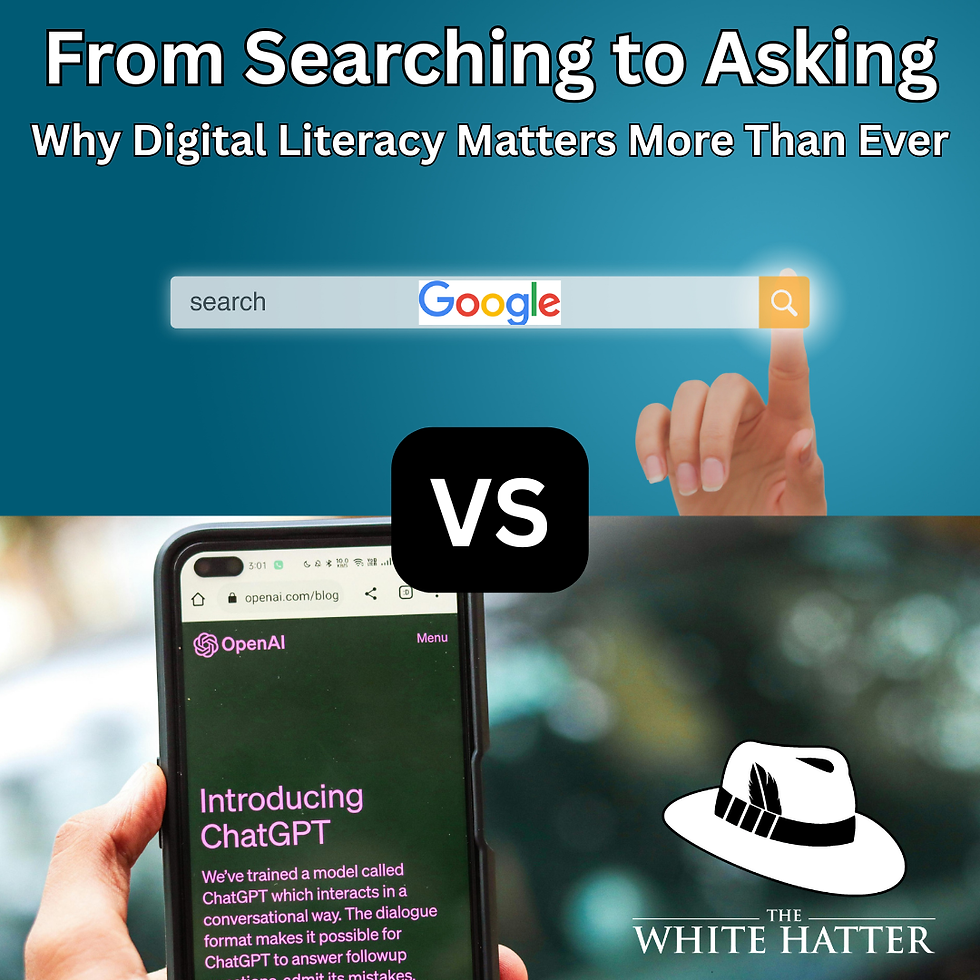
A quiet shift has already taken place in how youth and teens are starting to interact with technology. Not long ago, the internet was something you searched, where youth and teens typed words into a Google box and sifted through links. Today, the model has shifted. Youth and teens are no longer searching in the traditional sense, instead they are asking (what we now call “prompting”) through AI. With the growth of AI assistants, voice-activated devices, and conversational platforms, technology is being used less as a static index of information, and more as an interactive companion that provides answers.
This may seem like a small change, but we believe it may have enormous implications for how youth and teens learn, think, communicate, and stay safe online.
When youth and teens had to search for information online, they were required to frame their own questions carefully, judge the reliability of different sources, and compare multiple perspectives. That process, while sometimes frustrating, built critical thinking.
Now, many of those steps are being skipped. When youth and teens ask AI a question, they often get a single, and what appears to be a very polished answer. Sure, that is convenient, however, it can narrow perspective, reduce fact checking, and give the impression that one version of the truth is all that exists.
This shift does not mean the sky is falling from a learning perspective. Just as calculators changed math without eliminating the need for number sense, AI tools and conversational platforms are changing research without replacing the need for digital literacy. What it does mean is that parents, caregivers, and teachers have to adjust their approach.
For parents and caregivers, the key is to shift conversations away from just the content of what your kids are asking, and toward the process behind those questions. Instead of accepting the first answer that pops up, youth and teens should be encouraged to take a second look. Parents and caregivers can guide them to double check information, consult multiple sources, and push past the surface of a single response. By practicing this at home, whether during homework, family discussions, or even casual curiosity, youth and teens begin to understand that technology can provide quick answers, but thoughtful evaluation still matters.
For teachers, this change offers an opportunity to rethink classroom practice. Rather than simply asking students to “find three sources,” assignments can be designed to highlight differences between tools. For example, students might explore how a search engine, an AI assistant, and a trusted academic database each answer the same question. The goal is not just to collect information but to compare, contrast, and evaluate the reliability of what they find. This teaches students that knowledge is not static and that critical evaluation is just as important as retrieval.
Digital literacy has always been about more than knowing how to use apps. At its core, it’s about understanding how information is produced, how bias shapes it, and how we decide what to trust. In an age where youth and teens are asking more than searching, these skills become even more vital in our opinion.
One of the most important skills youth and teens can develop in today’s digital world, especially when it comes to AI, is the ability to recognize that answers do not appear out of thin air. Every answer comes from somewhere, whether it’s a search engine, a social media feed, AI, or even a friend. Each of those “somewheres” may carry its own biases, assumptions, or errors. Helping youth and teens to understand this builds the foundation for digital literacy. Instead of treating information as neutral or absolute, they begin to recognize that every source has a perspective, and that perspective can shape the message.
It’s equally important to encourage curiosity about why different tools often provide different results. A youth or teen might type the same question into two search engines, or two separate AI platforms, and receive answers that look quite different. That’s not just coincidence. Algorithms, company priorities, and even advertising influence what shows up on a screen. By asking youth and teens to think about why one tool highlights certain answers while another emphasizes different ones, parents, caregivers and educators can spark conversations about how technology itself influences what we see and believe.
Youth and teens benefit from seeing healthy skepticism modelled at home by parents and caregivers, and in the classroom by teachers. Even if an answer sounds polished, confident, or “official,” it does not mean it’s correct. Parents, caregivers, and educators can show how to test information by comparing it against other trusted sources, asking questions, and not settling for the first response. This kind of skepticism is not about doubting everything, it’s about teaching youth and teens to check their footing before they leap. In practice, this can look like saying out loud, “This sounds convincing, but let’s see what another source says.” Over time, your hand teens learn that critical thinking is not optional online, it’s essential.
Generation Alpha may never remember a time before “just asking” technology. That is why now is the moment to equip them with the habits and skills that will last. If searching shaped the skills of the past, prompting will shape the skills of the future.
Digital literacy is not simply about keeping up with the newest platform. It’s about helping youth and teens navigate a world where the way they think, learn, and communicate is shifting under their feet. Parents, caregivers, and teachers can’t stop tech development, but they can give youth and teens the balance to walk it with confidence, which is a learned skill!
Digital Food For Thought
The White Hatter
Facts Not Fear, Facts Not Emotions, Enlighten Not Frighten, Know Tech Not No Tech


