


When Online Safety Laws Remove Parents & Caregivers From the Equation

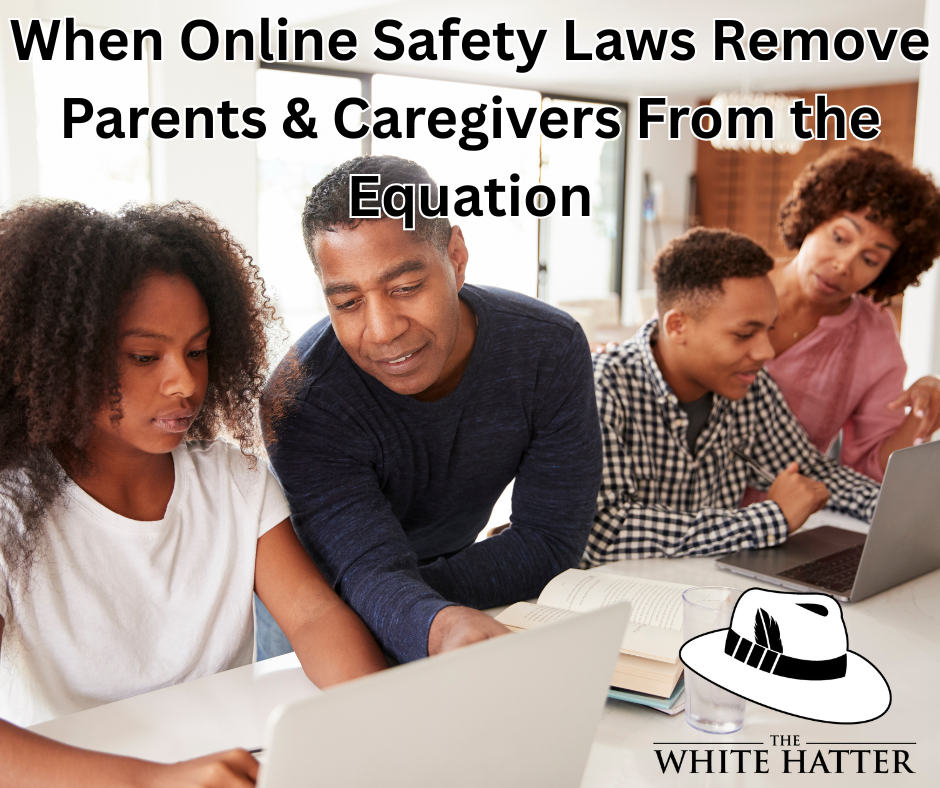
Caveat - We continue to hold the view that social media specific age gating legislation does little to meaningfully address the root causes of harm online. Limiting access based on age does not hold technology companies accountable for design choices, algorithms, and engagement systems that can place young people at risk. We have explored this in greater detail in earlier articles. (1)(2) At the same time, we recognize the broader political reality. As more countries move toward age based restrictions, a contagion effect is emerging. The pressure to “do something” is strong, and it is increasingly likely that some form of age gating legislation may be introduced or passed in Canada. If that occurs, our hope is that any legislation includes a clear parent exception clause. Such a provision would preserve parental decision making for families who are engaged, informed, and choosing supervised use based on their child’s individual readiness. This article explains why maintaining that parental role matters.
Most parents, caregivers, and digital literacy safety advocates agree on one core principle, children deserve protection online! That shared concern often drives legislation aimed at limiting youth and younger teens from access to some digital spaces. The challenge begins when those laws move beyond addressing harm and start overriding a parent or caregiver’s ability to make informed decisions about their own child’s digital life.
Online safety legislation is not just about risk, it’s also about development, responsibility, and trust. When legislation removes parent or caregiver decision making entirely, it does not simply protect children, it reshapes the family’s role in ways that deserve careful scrutiny.
From a child rights perspective, there is a real philosophical tension that is often ignored. Youth and teens have a right to protection from harm, however, they also have evolving capacities. As children grow, they gradually develop judgment, self-awareness, the ability, and the right to participate in decisions that affect their lives.
Digital spaces are now woven into how youth and teens learn, connect, and form identity. Treating all youth and teens as equally incapable of participation ignores developmental reality. It also dismisses the role that guided exposure plays in helping young people build digital literacy, agency, and resilience over time.
Removing access entirely does not eliminate risk. As we are seeing in other countries that have implemented age gating laws, it simply pushes risk out of sight, into less regulated spaces, while removing opportunities for teaching, mentoring, and shared problem solving. As Professor Timothy Koskie of the University of Sydney stated, “A ban's most significant impact may be as a "cultural touchstone" rather than actual technical enforcement.”
We find that many families, not all, are already navigating technology thoughtfully. Some introduce platforms gradually, some allow access with supervision and boundaries, while others delay use based on a child’s emotional readiness or past experiences.
Legislation that removes parental agency sends a troubling message that families cannot be trusted to make these decisions. That framing is not supported by what we see in practice. Parents and caregivers know their children better than any platform or policymaker. They understand their child’s temperament, vulnerabilities, strengths, and support systems.
When parents and caregivers are stripped of decision making authority, accountability weakens. Guidance turns into enforcement, and conversation turns into compliance. The relationship that research and lived experience show is most protective becomes secondary.
Not all online harm is created by access alone. Much of it is driven by design choices, algorithmic amplification, engagement based monetization, data extraction, and opaque systems play a far greater role in shaping risk than age by itself. Age based bans can feel decisive, but they are blunt instruments. They do little to address how platforms function or how harm is produced. They also fail to prepare young people for the digital environments they will eventually enter, often without the guidance that gradual exposure provides.
We have argued, and will continue to do so, that legislation addressing harm at the design level places responsibility where it belongs, on companies, systems, and structures, not solely on families.
A more balanced approach recognizes parents and caregivers as the mediating authority in their child’s digital life. That does not mean unrestricted access or hands off parenting. It means allowing families to decide what supervised, age appropriate participation looks like, while holding platforms accountable for safer design and meaningful safeguards.
Legislation should support parents with transparency, real controls, and safety by design standards. It should not replace them. Protection and participation are not opposites when informed adults are actively involved.
The goal of digital safety is not permanent restriction. It is helping young people develop judgment, literacy, and resilience so they can navigate online spaces responsibly as they grow.
Safety frameworks that rely only on restriction and prohibition are inherently fragile. They depend on control rather than understanding, and they tend to break down as soon as young people encounter workarounds, peer pressure, or unsupervised access. By contrast, safety built through strong relationships, shared context, and ongoing learning is far more durable. It equips youth and teens with the skills they need to navigate risk, not just avoid it temporarily.
Parents and caregivers do not need to be removed from the equation to protect children online. They are one of the strongest protective factors a young person has. When families are engaged, informed, and involved, they can guide use, set boundaries, and respond to challenges in real time. Effective policy should strengthen that role, not replace it.
For that reason, if age-gating legislation is adopted in Canada, it is essential that it include a clear parent exception clause. Such a provision would allow a parent or caregiver to authorize supervised participation on platforms that might otherwise be restricted, based on their child’s individual maturity and circumstances. This approach acknowledges that meaningful safety is not achieved by sidelining families, but by empowering them to be active partners in their child’s digital life. Some families may choose not to make use of such an exception, while others may decide it is appropriate for their child. Both choices can be valid at the same time, reflecting the reality that children develop differently and that families are best positioned to decide what meets their child’s individual needs.
Digital Food For Thought
The White Hatter
Facts Not Fear, Facts Not Emotions, Enlighten Not Frighten, Know Tech Not No Tech
Resources:


