


The Great Digital Misdirection: What Parents & Caregivers May Not Be Seeing in the Debate About Youth and Technology.
- The White Hatter

- May 30
- 7 min read

In today’s conversation about youth, technology, and online safety, some of the most persuasive messaging is not built on outright falsehoods. In fact, the most influential narratives are often rooted in partial truths, selectively framed research, emotionally compelling anecdotes, and carefully amplified messaging that leaves out complexity, nuance, and contradictory evidence. Here’s a great example that was posted online and received thousands of positive responses and reposts.

There is no credible evidence that watching short videos damages the brain “five times more” than alcohol and smoking combined. However, there is evidence based research which shows that excessive short form video use may be associated with reduced attention, weaker self-control, impulsive decision-making, sleep disruption, and reward-seeking behaviour, especially in those showing signs of compulsive use (1).
This is something parents and caregivers need to understand, especially when it comes to growing movements surrounding youth, teens, and their use of technology, the internet, and social media. While many individuals within these movements are genuinely well intentioned and motivated by concern for children, it is also important to recognize how modern influence dynamics can shape public perception in ways that simplify a much more complicated issue.
One of the most effective persuasion strategies is not to fabricate evidence, although that is happening as well, but to selectively present evidence that supports a predetermined conclusion while minimizing or excluding research that challenges it. Studies showing correlations between excessive or problematic technology use and negative mental health outcomes are often heavily promoted online. However, research showing more nuanced findings, mixed outcomes, or even positive effects associated with digital connection, creativity, learning, belonging, and community frequently receives far less attention (2). Why? Because nuance rarely spreads as effectively as certainty.
Statements such as, “social media is destroying an entire generation” are emotionally powerful, easy to repeat, and simple to understand. In contrast, saying, “The impact of technology on youth depends heavily on context, personality, family environment, socioeconomic conditions, developmental maturity, existing vulnerabilities, content type, and how the technology is being used,” is more accurate, but far less emotionally satisfying in a headline, podcast clip, documentary, or viral social media post.
This becomes even more influential when messaging is repeatedly amplified by what appear to be multiple independent voices. Parents and caregivers may encounter the same claims through podcasts, documentaries, influencer accounts, parenting groups, bestselling books, online summits, school presentations, and social media feeds. Although these sources may appear separate and unrelated, they often rely on the same limited pool of studies, experts, talking points, and emotionally charged examples. Over time, repetition can create the perception of overwhelming scientific consensus, even when significant debate and disagreement still exist within the broader research community.
Another important dynamic parents and caregivers should be aware of is audience targeting. Much of the emotional messaging surrounding youth and technology is specifically designed to resonate with mothers, and this is not accidental. Marketing, advocacy campaigns, and online influence strategies frequently recognize that mothers are often the primary consumers of parenting information and are more likely to engage with content centred on child safety and emotional wellbeing.
This can result in messaging that intentionally leans into parental fear, guilt, responsibility, and future regret. Phrases such as, “You only get one chance to protect your child,” are powerful because they activate emotional responsibility rather than encouraging balanced critical thinking.
Again, this does not mean every concern being raised is invalid. There are legitimate discussions to be had about persuasive design, algorithmic amplification, sleep disruption, compulsive habitual use patterns, online exploitation, privacy, unrealistic social comparison, and youth mental health. These are real issues that deserve thoughtful discussion and practical solutions.
However, problems arise when the conversation shifts from balanced digital literacy into absolutism, where all technology becomes framed as inherently harmful, where fear replaces nuance, or where parents are encouraged to believe that complete avoidance is the only responsible path forward.
The good evidence based research suggests that restriction alone does not build good digital judgment (3). Kids need guided practice, conversation, boundaries, and increasing independence to develop self-regulation online, for parents and caregivers, the key message is, “protection matters, but preparation matters too.” Rather than simply delaying access and hoping youth figure it out later, parents and caregivers should scaffold technology use the same way they teach driving which starts with supervision, provides coaching, allows practice, corrects mistakes, and gradually increases independence as experience and maturity grows.
This is where the work of James Randi becomes surprisingly relevant. Randi spent decades exposing how people could be persuaded to believe something was true, not necessarily because the evidence was strong, but because the presentation was emotionally convincing. As both a magician and professional skeptic, he understood the psychology of persuasion, authority, selective framing, misdirection, and the power of suggestion.
One of Randi’s greatest lessons was that manipulation often works best when people are not being directly lied to. Instead, they are guided toward certain conclusions while important context is quietly excluded.
That lesson applies directly to today’s online parenting narratives around technology. Much like a skilled illusionist, modern influence campaigns do not need to invent evidence. They simply need to spotlight the most frightening studies, repeat the most emotionally charged stories, amplify the most confident voices, and minimize the research, expert disagreement, and nuance that complicate the narrative.
Randi understood something deeply important about human psychology, intelligent, caring, and educated people are not immune to manipulation. In fact, strong emotions can make people more vulnerable to persuasive framing, especially when those emotions involve protecting children because fear, anxiety, and future regret are powerful motivators.
This is why parents and caregivers need to develop not just digital literacy about technology, but digital literacy about influence itself. Parents and caregivers should feel empowered to ask:
What am I being shown?
What am I not being shown?
Who benefits from this narrative?
Is this information balanced, or selectively framed?
Is fear being used to push me toward a predetermined conclusion?
At The White Hatter, we continue to advocate for a “redirect and pave the way” approach rather than a purely “delay is the way” approach. We arrived at this position by following the evidence wherever it leads, reviewing the full spectrum of research rather than limiting ourselves to studies that support a predetermined conclusion in what has become an increasingly polarized debate about youth and technology.
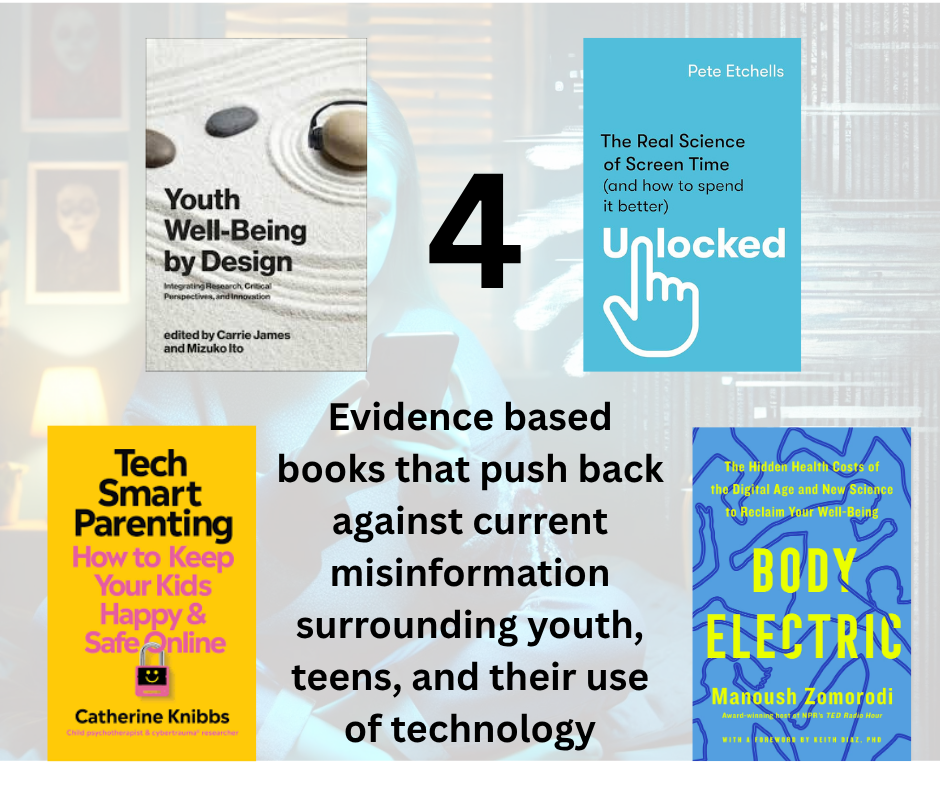
Over the past two years, a particular narrative about youth, technology, and social media has spread rapidly through books, documentaries, podcasts, news media, and social platforms. While some of the concerns being raised are legitimate, the conversation has often lacked balance and nuance. To help readers access a broader range of evidence and perspectives, we recommend the following four evidence based books that challenge prevailing assumptions and encourage a more critical examination of the research.
Technology is not disappearing, and artificial intelligence, algorithmically driven platforms, digital communication, immersive online environments, and AI powered systems will continue to shape the world our children inherit. The goal should not simply be to shield youth from technology for as long as possible, but to intentionally prepare them to engage with it safely, critically, ethically, and responsibly.
Good digital parenting is rarely found at the extremes, it’s usually found in the harder middle ground, where parents remain engaged, informed, communicative, and willing to adapt as both technology and their child evolve. Parents and caregivers deserve conversations grounded in evidence, context, balance, and honesty, not fear driven certainty packaged for clicks, engagement, book sales, online summits, ideological loyalty, or social media virility.
In today’s onlife world, digital literacy is not just about understanding apps, algorithms, or devices. It is also about understanding how influence works online, including how emotionally persuasive narratives can shape public opinion, parental anxiety, and even policy conversations.
As The Amazing Randi spent a lifetime teaching audiences, sometimes the most important question is not simply whether something is true. It is whether we are being shown the full picture.
Ultimately, one of the greatest risks in any public discussion is not simply getting the answer wrong, it’s directing our attention, energy, resources, and policy responses toward the wrong problem. When the response is aimed at the wrong target, the right target goes unfunded and unaddressed, what magicians call the art of misdirection.
If we convince ourselves that technology itself is the primary cause of every emotional, psychological, physical, and social challenge facing young people, we risk overlooking the many other factors that the good academic peer reviewed research consistently tells us matter. Family dynamics, mental health supports, economic stress, social isolation, childhood adversity, educational environments, sleep, community connection, and developmental vulnerabilities that all play significant roles in shaping youth wellbeing.
This is not an argument that technology should be ignored, it’s an argument that technology should be understood within the broader context of a youth or teen’s life rather than treated as a convenient explanation for every concern. When fear drives the conversation, simplistic solutions often follow, however, when evidence drives the conversation, more targeted and effective solutions become possible.
The question should never be whether technology presents risks, it certainly does for some people. The better question is whether we are accurately identifying which risks deserve our attention, which interventions are supported by evidence, and whether our efforts are addressing root causes rather than symptoms.
Parents, educators, policymakers, and communities deserve more than emotionally compelling narratives. They deserve the full picture because if we focus all of our attention on the wrong target, we may feel like we are taking action, while the issues causing the greatest harm continue to grow in the background, largely unseen and insufficiently addressed.
That is why digital literacy must include not only understanding technology, but also understanding how information, influence, and persuasion shape the conversations surrounding it. The goal when it comes to youth, teens, and their use of technology, the internet, and social media is to ensure that our decisions as parents, caregivers, and educators, are guided by evidence, context, and critical thinking, something that we strive for here at the White Hatter!
Digital Food For Thought
The White Hatter
Facts Not Fear, Facts Not Emotions, Enlighten Not Frighten, Know Tech Not No Tech
References


