


The “Cat in the Hat” Hoax: What Canadian Parents Need to Know

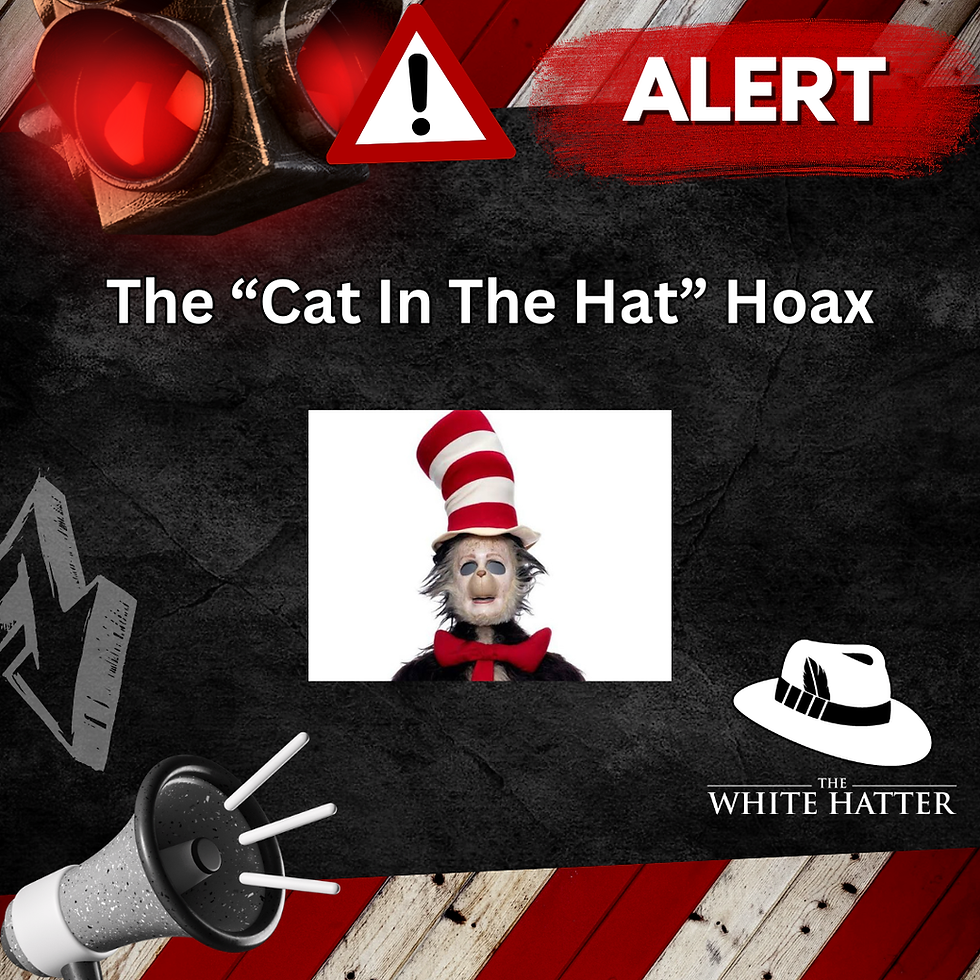
Caveat - Thank you to the Canadian parent who brought this to our attention!
Over the past couple of weeks, we have been watching a concerning social media trend known as the “Cat in the Hat” hoax spread from Ireland and the United Kingdom into the United States. With Canadian students now returning to school, we wondered how long it might take before we started hearing about similar posts appearing here in Canada. Yesterday, we received our first report from a concerned Canadian parent.
A Canadian parent contacted us after her son had been tagged in a TikTok post connected to the Cat in the Hat trend, which named their city with the note “Coming for all of you guys” and “If you want to see the cat in the hat come to the high school”. Understandably, the parent was concerned about her son’s safety and wanted to know what the post meant and whether she should take it seriously, and that is why we are publishing this article. Here's the picture that was posted (we purposely blurred out the city)

At the time of writing, we have not located a public statement from Canadian law enforcement or a Canadian school district confirming a Canadian incident connected to this trend. One report to us does not establish that the broader trend has taken hold in Canada. However, given how quickly it has travelled internationally, we believe Canadian parents, caregivers, educators, and students should understand what is happening before fear and rumours get ahead of the facts.
What Is the “Cat in the Hat” Hoax?
The trend takes the familiar Cat in the Hat character created by Dr. Seuss and transforms it into something resembling a horror character or serial killer.
AI generated and manipulated images and videos depict a sinister looking Cat supposedly wandering through neighbourhoods, standing outside homes and schools, or appearing on security cameras. The trend gained significant attention in Ireland in August 2026, where police reassured the public that frightening images supposedly showing the character in communities were fabricated rather than evidence of an actual person stalking neighbourhoods.
The trend subsequently spread into the United Kingdom and United States, where something more concerning began happening. Some users started localizing the hoax by naming actual communities and schools and, in some cases, tagging or identifying individual students. This is exactly what happened in the incident that was reported to us.
There is no evidence that a fictional Cat in the Hat serial killer is roaming communities looking for children. However, once someone takes a hoax and attaches the name of a real child, school, home, or community to threatening content, there can be legitimate reasons for concern.
Authorities in several U.S. jurisdictions have investigated Cat in the Hat posts targeting schools and students. Some posts have included specific locations, lists of names, or language suggesting that the character was “coming for” particular people. Investigations have resulted in increased police presence around schools, disruptions to classes, and arrests of young people allegedly involved in creating threatening posts.
This leaves parents with two important questions, “Is the Cat in the Hat story real? No! and “Should a post specifically naming or threatening my child or their school be reported?” Yes. Those two things can be true at the same time.
We Have Seen This Before: The 2016 Creepy/Killer Clown Scare
For parents experiencing a sense of deja vu, there is a good reason. Almost exactly ten years ago, in the late summer and fall of 2016, the so called “creepy clown” or “killer clown” scare spread across social media.

The phenomenon began gaining widespread attention in the United States following reports of sinister looking clowns supposedly appearing in communities and, in some cases, attempting to lure children. As media coverage and social media attention grew, additional sightings, photographs, videos, rumours, and threats began appearing across North America.
Some incidents involved people actually dressing as clowns. Others were pranks, fabricated reports, or claims that could never be substantiated.
Eventually, social media accounts began mentioning actual schools and students. Police investigated threats, schools responded, classes were disrupted, and some young people were arrested.
The phenomenon eventually crossed into Canada as well. Here in British Columbia, North Vancouver schools warned parents after students reportedly made social media threats involving clowns and a middle school. RCMP investigated and determined the threats were unfounded. Police elsewhere in Canada dealt with similar reports. Eventually, the creepy clown scare faded.

Ten years later, the character has changed, but the underlying human behaviour looks remarkably familiar. However, there is one major difference, the barrier to creating convincing fake content has collapsed. Ten years ago, someone wanting to create convincing creepy clown content might have needed a costume, a staged photograph, video editing skills, or image manipulation software. Today, generative AI can potentially place a frightening character outside a recognizable school, house, playground, or neighbourhood within seconds. No costume, no physical presence, and no advanced editing skills needed. However, a student scrolling quickly through TikTok may see the resulting image and think, “Wait, is that our school?”
AI didn’t invent hoaxes, rumours, pranks, school threats, or teenagers trying to frighten one another. What AI has done is make convincing synthetic content significantly easier to create, personalize, and distribute. That is why this isn’t simply an “AI problem”, it’s an old human behaviour, being amplified by a powerful new technology.
A Hoax Can Be Fake While the Consequences Are Real
Calling something a hoax does not mean everything surrounding it should be ignored. Imagine someone creates an AI generated image showing the Cat in the Hat outside your child’s school and then adds your child’s name and the names of several classmates with a message suggesting the Cat is “coming for them.”
Here in Canada, something being intended as a hoax, prank, meme, or social media trend does not necessarily protect the person who created or shared it from legal consequences. Depending on the specific words used, who or what is targeted, and the surrounding circumstances, a post that communicates a threat, causes people to reasonably fear for their safety, targets a school, or deliberately triggers a police or emergency response could potentially result in a criminal investigation and, in some circumstances, an arrest and charges.
This is particularly important for young people to understand. Saying afterward, “It was only a joke,” “I didn’t mean it,” or “Everyone knows the Cat in the Hat isn’t real” does not automatically erase the impact of what was posted or prevent police from investigating. Context matters. A silly AI generated image of the Cat in the Hat is one thing. Adding the name of a real school, identifying specific students, tagging a classmate, or including language suggesting that someone will be harmed can turn what a young person believes is an online joke into something significantly more serious.
Under the Canadian Criminal Code, depending on the circumstances, threatening online content could potentially engage offences such as uttering threats (s. 264.1) or, in some situations, public mischief (s. 140) where someone deliberately causes police to investigate an offence they know did not occur. Other Criminal Code provisions could potentially apply depending on exactly what was done. Whether an offence has actually occurred is ultimately determined by the evidence, circumstances, applicable law, and the police and Crown, not simply by whether the person who posted it considered it a joke.
This is why our messaging to youth and teens is simple, “before participating in a viral hoax, prank, or AI-generated trend, think about how that post would look to someone who doesn’t know you’re joking.” If police, a school administrator, a parent, or the person you’ve named cannot distinguish your “joke” from a genuine threat, the consequences can become very real very quickly. The Cat in the Hat may be fake, however, the police investigation that follows a threatening post may not be.
If your child is named or tagged in one of these posts, don’t panic, but don’t ignore it either. Preserve the evidence and take screenshots showing the post, username, profile, caption, comments, date and time where available. If it’s a video, consider making a screen recording before the content disappears or is deleted.
Don’t have your child confront the account, and don’t immediately repost the content publicly asking other parents whether they know anything about it. Doing so can unintentionally amplify the hoax.
If the post identifies your child, their school, their home, or another specific location, particularly when accompanied by threatening language, report it to the school and appropriate local law enforcement. Let those responsible for assessing threats determine whether further investigation is required.
There is an important difference between taking a potential threat seriously and believing the threat is true. Don’t feed the algorithm because attention is oxygen for viral hoaxes. Every repost, reaction video, frightened Facebook post, and speculative discussion can introduce the content to another audience. Social media algorithms don’t necessarily understand that you are sharing something because you are worried about it. Engagement can still help distribute it. Sometimes our attempts to warn others about a hoax inadvertently become part of the mechanism spreading it.
Instead of sharing the frightening video itself, share credible information. Link to police or school statements where available. Don’t identify children who have been targeted, speculate about who created the content, or turn an unverified TikTok into a community-wide emergency before authorities have assessed it. Report rather than amplify.
If your child has encountered the trend, ask what they have seen, what their friends are saying, whether anyone they know has been tagged, and what they think is happening.
You may discover they already know it’s fake. You may discover they’re frightened. You may also discover they understand considerably more about how the trend is circulating among students than adults do.
The Character Changes, But The Human Behaviour Doesn’t.
Ten years ago, it was creepy clowns, today, it’s an AI-generated Cat in the Hat, and tomorrow it will be something else. That is why simply warning children, “Don’t participate in the Cat in the Hat trend,” isn’t enough. We need to teach them how to respond when the next viral scare arrives.
Pause before reacting.
Verify before sharing.
Don’t tag friends in threatening content.
Don’t create threatening posts simply because they’re part of a trend.
Preserve and report content that specifically targets you.
Talk to a trusted adult when something online genuinely frightens you.
Most importantly, parents need to make sure their children know they can bring concerning online content to you without being ridiculed, immediately punished, or automatically having their technology taken away.
The Canadian parent who contacted us after her son was tagged did exactly what we hope parents will do. She didn’t assume the worst, but she didn’t ignore it either. She sought more information so she could determine what she was actually dealing with.
Don’t panic, don’t dismiss, preserve any evidence, verify, and report when appropriate. Ten years ago, the frightening character was a creepy clown. Today, it’s an AI generated Cat in the Hat.
Digital Food For Thought
The White Hatter
Facts Not Fear, Facts Not Emotions, Enlighten Not Frighten, Know Tech Not No Tech


