


September Is Suicide Awareness Month: Why Parents and Caregivers Need to Be Part of the Conversation

Updated: Sep 3

Caveat: This is not an easy topic for us to write about, and for some it will not be an easy article to read. Suicide is also something that has touched our own family. Our co-founder, Darren, lost an extended family member to suicide, a loss that brought home in a deeply personal way the questions, grief, and lasting impact that can follow a suicide. During his more than 30 years in policing, he also attended dozens of suicides and witnessed first hand what was left behind for parents, partners, children, relatives, friends, and communities.
We share this not to suggest that Darren’s experiences are the same as anyone else’s, because every suicide and every family’s experience of loss is different. We share it because this topic is more than academic for us. Behind the statistics and research cited throughout this article are real people and real families, something Darren has witnessed both personally and professionally.
Research suggests that suicidal ideations and self harm among children and adolescents follows a school-year pattern, tending to decline during summer vacation and increase again as young people return to school, with elevated rates often continuing through the fall and spring (1). With a new school year beginning across Canada, we believe September is a particularly important and timely month to bring greater awareness to youth and teen suicide.
Avoiding conversations about suicide does not make suicide disappear. In fact, one of the most persistent myths surrounding suicide is the belief that asking someone whether they are thinking about suicide might somehow “put the idea into their head.” Research does not support that belief. Talking openly, calmly, and compassionately about suicide can create an opportunity for someone who is struggling to finally tell another person what they are experiencing. (2)
September is Suicide Awareness Month, and for those of us who work with children, youth, teens, families, and schools, it provides an important opportunity to have conversations that many people understandably find uncomfortable.
Suicide is not simply a mental health statistic. Behind every number is a person, a family, friends, classmates, teachers, teammates, colleagues, and communities whose lives can be profoundly changed. For parents and caregivers, perhaps the most important message this month is that suicide prevention does not begin when a young person reaches a crisis point. It begins much earlier, in the relationships we build with our children, the environments we create around them, our willingness to notice when something has changed, and our ability to have difficult conversations when those conversations are needed.
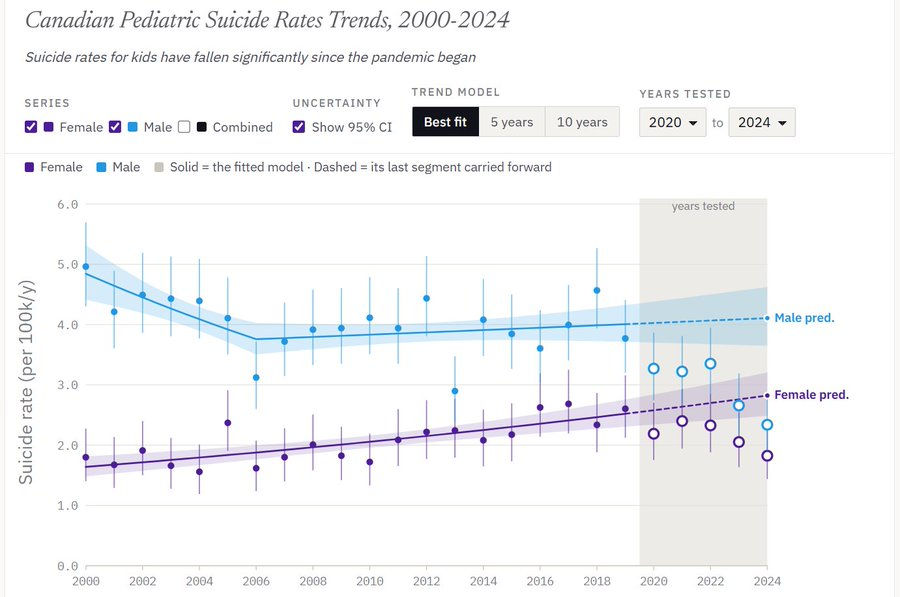
Here in Canada, the numbers remind us why this deserves our attention. According to the Public Health Agency of Canada’s most recent surveillance data, approximately 4,750 people die by suicide in Canada each year, or roughly 13 people every day. Suicide remains the second leading cause of death among youth and young adults between the ages of 15 and 34. In preliminary 2024 data, the suicide mortality rate was 2.2 per 100,000 among children aged 10 to 14 and 7.7 per 100,000 among youth aged 15 to 19 (3)(4).
However, deaths tell us only one part of the story. Canadian data from the 2023 Canadian Health Survey on Children and Youth found that 8.4% of youth between the ages of 12 and 17 reported having thoughts of suicide (suicidal ideations) during the previous 12 months. Older teens were particularly important to pay attention to, because youth between 15 and 17 had approximately twice the prevalence of suicidal ideation as those between 12 and 14 (5).
A recently published peer reviewed Canadian analysis of the same nationally representative survey, involving 11,899 adolescents between 12 and 17, similarly found that 8.4% reported suicidal ideation during the previous year and 4.6% reported having attempted suicide at some point in their lives. Females reported higher rates than males, and older adolescents had substantially greater odds of reporting both suicidal thoughts and attempts than younger adolescents (6). Those are not numbers that should cause parents to panic, they are numbers that should encourage us to pay attention.
Important Note - Despite growing concern about the mental health of Canadian youth, national data do not show a simple decade long surge in teen suicide deaths as some want you to believe. Suicide mortality has fluctuated but has stayed fairly stable, while suicidal thoughts and attempts remain significant concerns. In fact, according to Dr Tyler Blacl, from 2020-2025 the suicide rate for youth has fallen (-20% for girls and -27% boys). This distinction matters because worsening measures of youth mental health should not automatically be presented as evidence that suicide deaths are rising!
Suicide Rarely Has One Cause
One of the biggest mistakes we can make when discussing youth suicide is searching for a single explanation. It is tempting to look at whatever issue currently dominates public discussion, whether that is social media, smartphones, bullying, academic pressure, family conflict, substance use, pornography, gaming, or something else, and identify it as the reason young people are struggling. Human behaviour rarely works that way, and suicide certainly doesn’t.
Suicide is complex and usually involves an interaction between multiple individual, relational, environmental, social, and psychological factors. Depression and other mental health difficulties can play an important role, but so can hopelessness, isolation, trauma, bullying, discrimination, family conflict, relationship breakdowns, substance use, feelings of burdensomeness, difficulties at school, and the belief that whatever pain someone is experiencing will never end.
An important Canadian study published in The Canadian Journal of Psychiatry examined these factors among Ontario students in Grades 7 through 12. Researchers looked at school connectedness, perceived availability of support, self-esteem, hopelessness, feelings of worthlessness, bullying and cyberbullying, substance use, and social media use when examining suicidal ideation. Their findings reinforce something parents need to understand, youth suicide cannot responsibly be reduced to a single behaviour, platform, technology, or environmental influence (7).
Sometimes what appears insignificant to an adult can feel enormous to a teenager. A friendship ending, being excluded from a peer group, a romantic breakup, an embarrassing picture being shared, academic failure, family conflict, being bullied, sexual orientation or gender related stress, losing a team position, or feeling that they have disappointed someone can become overwhelming when combined with other vulnerabilities. Adults have decades of lived experience telling us that circumstances change, a 14-year-old does not, and that difference matters.
One Canadian study deserves particular attention from parents and caregivers. Researchers examined cases of near fatal self-harm involving Canadian adolescents. Interpersonal conflict was the most frequently identified precipitating factor, appearing in approximately 70% of cases. Family conflict was reported in 46.2%, romantic relationship conflict in 23.7%, and peer conflict, including bullying and cyberbullying, in 22.6%. Academic difficulties, abuse, sexuality or gender related difficulties, and exposure to suicide in a school or community were also identified (8).
However, one finding particularly caught our attention. Parents or caregivers were reported as knowing that their child was considering suicide in only 26% of the cases. That does not mean those parents or caregivers didn’t care or weren’t paying attention. It demonstrates something every parent and caregiver needs to understand, a young person can be experiencing extraordinary emotional pain while appearing comparatively functional to the people around them.
Some youth continue attending school, continue playing sports, laugh with friends, post online, play video games, eat dinner with their family, and they may even make plans for the weekend. There is not always an obvious flashing warning sign telling a parent or caregiver that something is seriously wrong. This is one reason ongoing communication matters so much.
Given the work that we do here at The White Hatter, we also need to talk about technology. Young people don’t live separate “online” and “offline” lives anymore. Their friendships, relationships, conflicts, entertainment, education, identities, communities, and social lives frequently move between physical and digital environments, something we call their “onlife world”. That means experiences occurring online can absolutely become relevant to suicide prevention.
Canadian research involving students in Grades 7 through 12 found that youth experiencing cyberbullying had substantially higher odds of reporting suicidal thoughts, plans, and attempts than youth who had not experienced cyberbullying. Importantly, researchers found that depression played a major mediating role in these relationships (9).
More recent Canadian longitudinal evidence strengthens the reason we should pay attention to digital peer aggression. A 2026 nationally representative study followed 4,930 Canadian youth using data from the Canadian Health Survey on Children and Youth collected in 2019 and 2023. Researchers examined whether digital peer aggression during adolescence predicted later depression, anxiety, suicidal ideation, and suicide attempts while accounting for factors including earlier mental health, demographics, online activity, and traditional bullying. The research adds to growing evidence that what happens to young people online can have consequences extending beyond the moment when the online incident occurs (10).
However, there is an equally important caution here. We should not make the mistake of turning “social media” or “screen time” into a convenient explanation for youth suicide. A nationally representative Statistics Canada study involving approximately 13,600 adolescents aged 12 to 17 found associations between some forms of digital media use and poorer mental health outcomes. However, some associations weakened or disappeared after factors such as digital peer aggression and adequate sleep were considered. The researchers specifically emphasized that different digital activities appear to have different relationships with mental health and that these associations can differ between boys and girls (11).
In other words, the important question is often not simply, “How much time is my child spending online?” A more useful set of questions might include, What are they doing online? Who are they interacting with? How are those experiences making them feel? Are they being bullied, threatened, sexually exploited, excluded, humiliated, or harassed? Is technology displacing sleep, physical activity, family interaction, or other important parts of their life? Conversely, are online communities providing friendship, identity, belonging, creativity, or support that may actually be protective? Context matters!
If there is one recurring theme within suicide prevention research that deserves far more attention, it is connection. Young people need to feel that they matter to someone. They need adults who notice them, listen to them, and take them seriously. They need places where they feel accepted and people they believe they can approach when life becomes difficult.
A study examining school connectedness among Canadian adolescents found that stronger connections to school were associated with lower suicidal behaviour, even when researchers considered depression and other potential confounding factors (12).
Another study examining socially vulnerable adolescents found that young people who reported stronger connections with parents also reported lower levels of depressive symptoms, suicidal ideation, and non-suicidal self-injury. Greater school connectedness was similarly associated with lower depressive symptoms and suicidal ideation (13). This is something parents and caregivers can actually influence:
We cannot remove every difficulty from our child’s life.
We cannot control every friendship.
We cannot prevent every breakup.
We cannot eliminate every hurtful comment.
We cannot control everything they see online.
We cannot guarantee that our children will never experience anxiety, depression, rejection, bullying, embarrassment, grief, or failure.
However, we can work very hard to ensure they know where they can go when those things happen. The goal isn’t to raise children who never experience adversity. The goal is to help create young people who know they do not have to experience adversity alone.
Parents and caregivers sometimes tell us that one of their greatest fears is asking their child directly about suicide. They worry, “What if I put the idea into their head?” The evidence on this point is reassuring. As mentioned at the start of this article, review of research examining both adolescents and adults found no statistically significant evidence that asking people about suicide increased suicidal ideation. Some evidence suggested that asking may actually reduce distress or encourage people to disclose what they are experiencing.
More recent research involving children between eight and twelve similarly found no evidence that repeatedly screening young people about suicide increased suicidal thoughts, including among children already considered at elevated risk (14).
If you are genuinely concerned about your child, it is okay to ask clearly, “Have you been thinking about suicide?” You don’t need a psychology degree to ask that question, but you do need to be willing to hear the answer.
If the answer is yes, try not to react with shock, anger, disbelief, or an immediate lecture, just listen. Thank them for telling you, stay with them, take what they are saying seriously and connect them with appropriate professional support in your community. A young person telling you they are thinking about suicide is not something you need to solve by yourself, however, It is something you need to respond to as the parent or caregiver.
Parents and caregivers are frequently given lists of suicide warning signs. Those lists can be useful, but they can also create a false sense that suicide risk always presents in a predictable way. Instead, we encourage parents to pay attention to meaningful changes from their child’s normal behaviour (15). That might include withdrawing from friends or activities they normally enjoy, significant changes in sleep or eating, increasing substance use, persistent hopelessness, suddenly giving away valued possessions, talking about being a burden, repeatedly talking about death, saying that others would be better without them, dramatic mood changes, significant changes in school attendance or performance, withdrawing socially, or suddenly saying goodbye to people in ways that seem unusual.
Online behaviour can sometimes provide clues as well. Posts about hopelessness, death, feeling worthless, saying goodbye, believing nobody would care if they disappeared, or searching for suicide related content should not automatically be dismissed as attention seeking. Sometimes seeking attention is exactly what someone in distress needs to do. The appropriate response is curiosity and care, not ridicule or punishment.
There is another point that we believe is important. Awareness campaigns can sometimes unintentionally create the impression that youth suicide is everywhere and constantly increasing, however, the Canadian evidence is more nuanced than that.
A 2024 systematic review and meta analysis examining 35 Canadian studies of youth mental health during the COVID-19 pandemic found considerable variation between studies and noted that many had important methodological limitations. Although anxiety and depression increased in many populations, suicide related outcomes did not move uniformly in the same direction across every study or population (16), and that distinction matters.
Evidence based suicide prevention should inform parents without frightening them. Fear can make adults hypervigilant which can cause us to interpret every bad day, closed bedroom door, argument, or sad social media post as evidence of imminent danger.
Teenagers experience emotional highs and lows. They sometimes withdraw, become angry, and say things they don’t mean. Our job as the parent or caregivers isn’t to diagnose every emotion, our job is to remain close enough that when something genuinely changes, we notice.
Suicide Awareness Month provides an opportunity to start conversations, but suicide prevention cannot be confined to September. The most powerful protective work often happens during ordinary moments throughout the year:
It happens when your child comes home upset and you listen before offering solutions.
It happens when they make a mistake and discover they can still come to you.
It happens when they tell you something uncomfortable and your first response isn’t punishment.
It happens when they fail a test, lose a friend, get dumped, experience online cruelty, or make a poor decision and discover that their relationship with you survived.
It happens when we teach young people that asking for help is not weakness.
It happens when children learn through experience that there is nothing they could tell us that would make us stop loving them.
That doesn’t mean removing boundaries, consequences, expectations, or accountability. It means ensuring that underneath all of those things remains a relationship.
September’s Suicide Awareness Month shouldn’t be about frightening parents and caregivers, it should be about reminding us of something incredibly important:
Connection can save lives.
Conversation can save lives.
Paying attention can save lives.
Asking the difficult question can save lives.
We often say that when it comes to parenting in today’s onlife world, technology will change, apps will change, platforms will change, and the challenges facing young people will change, but the human element remains steadfast.
Build the kind of relationship today that makes you one of the people your child will turn to when life becomes difficult tomorrow. You may never know just how important that relationship becomes.
If You or a Young Person Needs Help in Canada
If someone is thinking about suicide or you are worried about someone, Canada’s 9-8-8 Suicide Crisis Helpline is available 24 hours a day, 365 days a year by calling or texting 9-8-8. If someone’s safety is at immediate risk or they have seriously harmed themselves, call 9-1-1 or go to the nearest emergency department (17).
Young people across Canada can also contact Kids Help Phone by texting CONNECT to 686868 for confidential crisis support, available 24/7/365 (18).
Digital Food For Thought
The White Hatter
Facts Not Fear, Facts Not Emotions, Enlighten Not Frighten, Know Tech Not No Tech
References
17/ https://988.ca/


